SCANDAL BREAKING LARGE: GRASPING "LEARNED HAND" - SECRET PALANTIR AI IN LOS ANGELES COURTS DISCOVERED
"AI for Me, not for Thee"

[CalMatters/KPBS investigation published May 26 by reporters Cayla Mihalovich and Khari Johnson reported by Kyle Belmonte this week]
Is AI for Law “Officially” doing “AI for Me, Not for Thee” ?
BREAKING HARD THIS FRIDAY MORNING
Southern California Courts are Quietly Testing “Learned Hand” AI Clerk — Without Telling Litigants
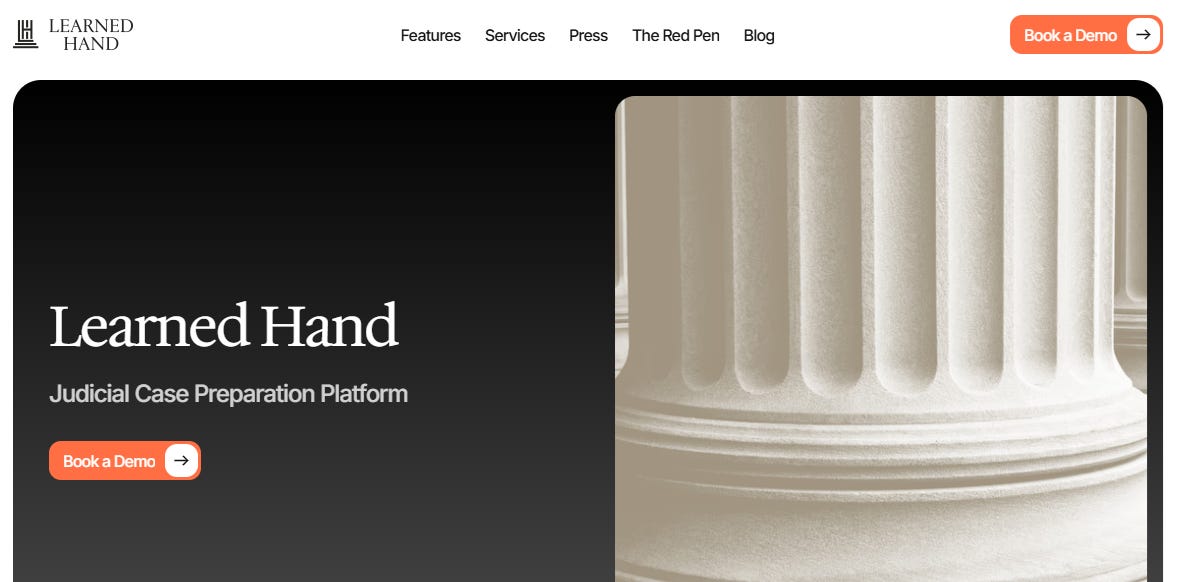
A CalMatters investigation published May 26, 2026, reveals that two of California’s largest superior courts — Los Angeles County and Riverside County — have begun pilot programs using an AI tool called Learned Hand to help judges and court staff with legal research, motion summaries, and drafting rulings and memos.
Learned Hand is a generative AI platform designed as an impartial “AI law clerk” for judges and court staff, assisting with case preparation, legal research, motion summaries, bench memos, and tentative ruling drafts while using source-grounded verification to minimize hallucinations.
It was founded by Shlomo Klapper, a Yale Law School graduate who previously litigated at Quinn Emanuel Urquhart & Sullivan and served as a deployment strategist at Palantir Technologies.
Details of the Pilots
Los Angeles County Superior Court (largest trial court in the U.S.): Launched its pilot in February 2026 with a roughly $314,000 contract.
Six judges and their research attorneys (primarily in civil cases) are using the tool to summarize motions, conduct research, and assist in drafting tentative rulings.
The contract includes a roadmap that could expand the AI into criminal, family, and probate divisions — including testing on already-decided motions for things like evidence-suppression motions and post-conviction relief.Riverside County Superior Court: Signed a smaller $10,000 agreement in February 2026.
Seven civil and probate attorneys are using it mainly to draft research memos that help judges decide cases. It is not currently drafting tentative rulings.
The Non-Disclosure Issue - Partial is Secret
The central revelation in the reportage is the lack of transparency:
Litigants and the public are not being told when Learned Hand AI is used on their cases.
Current court policies in both counties require disclosure only if an entire motion, decision, or document is written by generative AI. Partial assistance (research, summaries, drafting help) does not trigger any notice requirement.
Court spokespeople declined to confirm whether parties are aware the tool is being tested on their matters. Judges themselves only learned about the LA contract during a March 2026 presentation.
Concerns Raised
Critics — including anonymous LA judges, the LA County District Attorney, and public defenders — warn that using AI in high-stakes criminal cases (especially Racial Justice Act claims) risks bias, hallucinations (fabricated citations), and erosion of public trust in the judiciary.
One judge called it “an extremely perilous road” that “dehumanizes the whole process.” Others worry AI cannot handle nuanced social and racial dynamics.
Court officials emphasize that judges retain full oversight and must review/edit all AI output.
The pilots are framed as careful experiments to tackle massive backlogs amid staffing shortages.The story has also been picked up in condensed form by outlets like AI Weekly, which highlighted the “skip disclosure” aspect and potential due-process implications.
Bottom Line
While courts are quietly embracing AI to speed up justice, the lack of mandatory disclosure means parties in active cases often have no way of knowing — or challenging — whether an AI clerk helped shape the rulings against them. The pilots are still in early stages, with quarterly evaluations planned.
And why are courts doing hyper-generalized, unreliable LLMs for official law?
AAAANNNNDDDDD if attorneys are being professionally abused for their mere use of AI in their pleadings and litigation, while courts have a free learned hand to do as they please without oversight…